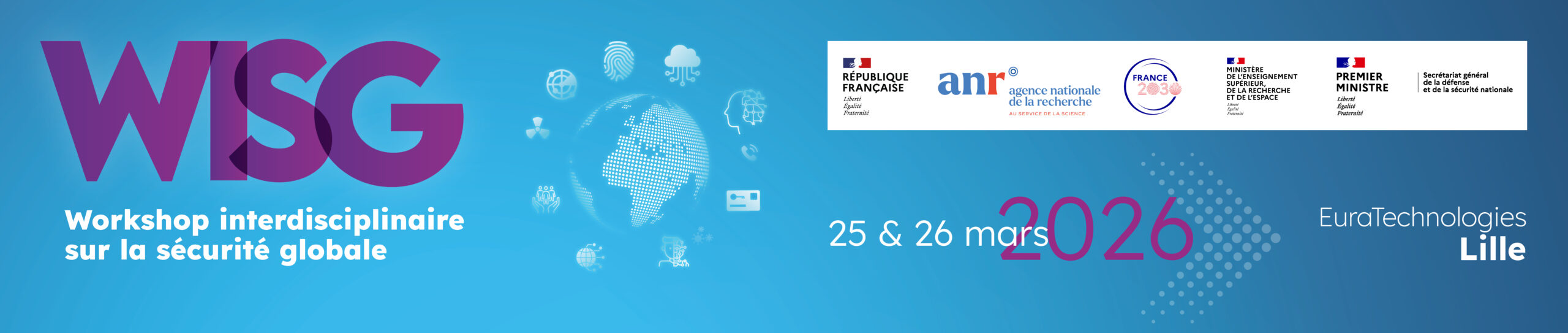
The event will be held in French (except for Session 3, in English).
Translation headsets will be available at the registration desk.
9:15 a.m.
10:00 a.m.
Introduction
Welcome speech by Chekib GHARBI, Director of the Hauts-de-France Cyber Campus – Lille Metropolitan Area and Member of the Executive Board of Euratechnologies
→ Claire GIRY, President and CEO, ANR
→ Préfet Xavier BRUNETIÈRE, Director of State Protection and Security, SGDSN
→ Julie MERCIER, Director of Security Companies, Partnerships and Weapons (DEPSA), Ministry of the Interior
SESSION 1 – CONFRONTING THE SURGE IN CYBERCRIME: WHAT RESPONSES?
Learn more
Cybercrime is surging significantly in France and worldwide, driven by substantial resources and a convergence of interests between organized crime networks and certain states.
After a presentation of the threat, the session will explore protection, response, and prevention from the perspectives of citizen protection, as well as legal and scientific stakeholders.
Moderator: Géraud CANET, Co-Director of the PEPR Cybersecurity program and Program Manager for the “From Component to Digital Systems and Infrastructures” (ASIC) agency, coordinated by the CEA
10:30 a.M.
Opening keynote on the state of the threat
→ Général Hervé PÉTRY, Commander, National Cyber Unit, French Gendarmerie
Keynote speaker (remote intervention):
Use cases, examples of attacks
→ David BIZEUL, cofounder and Chief Scientific Officer, Sekoia.io
Keynote speaker :
Legal and judicial measures
→ Myriam QUÉMÉNER, Honorary Magistrate, PhD in Law
Roundtable discussion with contributions from:
→ Teodora CURELARIU, PhD Candidate in International Law and Cybersecurity at Université Grenoble Alpes, in partnership with Inria and CyberAlps
→ Jean-Yves MARION, Professor at the University of Lorraine, member of the Institut Universitaire de France, lecturer at Mines Nancy, and researcher at LORIA
→ Général Hervé PÉTRY, Commander, National Cyber Unit, French Gendarmerie
→ Didier ROSSELIN, Honorary Chief Commissioner, Coordinator of Research and Innovation Programs at the National Higher Police School (ENSP)
→ Myriam QUÉMÉNER, Honorary Magistrate, PhD in Law
12:15 p.m.
Lunch
13:45 p.m.
Parallel sessions
Auditorium l Lessons learned from the French-German call for proposals on preparedness and rapid response to biological threats
Learn more
Biological threats and hazards do not stop at national borders. To cope with crises that arise from such events, international cooperation is crucial. At the 6th Forum on German – French Cooperation on June 19, 2018, a joint call was launched with the BMBF, VDI, ANR, and SGDSN, aimed at strengthening effective cooperation between researchers, practitioners, and other professionals in the field of crisis prevention and response to threats and hazards caused by epidemic or pandemic outbreaks, technical disasters, or intentional malicious release of biological agents. This session will discuss the results of the selected projects. The project leaders will share their experience of the technological aspects and will address the benefits of interdisciplinarity and bilateral cooperation.
Moderator: Jean-Nicolas TOURNIER, Scientific Director, CEA, and former Head of the CBRN Division at iRBA
With contributions from the coordinators of the following projects:
DEFERM
Decontamination measures to restore facilities and the environment after a natural or deliberate re-lease of pathogenic microorganisms
→ Jean-Claude MANUGUERRA, Head of the Emergency Biological Response Unit, Institut Pasteur
PLANT
Priority to threats posed by plant toxins: management, detection, forensics and therapeutics in a bioterrorism incident taken to the next level
→ Stéphanie SIMON, Director of Research and Head of the Medicines and Health Technologies Department, CEA
PREPMedVet
Preparedness and Response in an Emergency context to Patho-gens of MEDical and VETerinary importance
→ Stephan ZIENTARA, Veterinarian and Virologist; Director of the Animal Health Laboratory, French Agency for Food, Environmental and Occupational Health & Safety (Anses)
XBAT
Research on and generation of a decavalent equine Antitoxin counteracting deliberate botulinum neurotoxin attacks
→ Emmanuel LEMICHEZ, Research Director, INSERM; Head of the “Bacterial Toxins” Unit, Institut Pasteur, Paris
Conference room l Workshop l Countering the Malicious Use of Drones
Learn more
From the outset of the war in Ukraine, the rapid rise in drone usage has revealed a profound transformation in engagement methods, with nearly 90% of human casualties and 70% of vehicle losses now attributed to them. Beyond their impact on the conflict, the 7,000 drones produced daily by Ukraine could pose a significant risk of proliferation across Europe. The sequences of overflights initiated in Ukraine (Operation Spiderweb), and gradually extended to Europe in 2025, have illustrated the asymmetry enabled by drone usage. To counter this disruptive capability and the initial impunity, France is now stepping up efforts, notably with political-level engagement on the issue. In order to guide ongoing research according to national security needs related to this challenge, this roundtable will address both the complementarity and the level of maturity of deployed technologies, as well as commercial and innovation prospects.
This specific session will be conducted in French only, without translation.
Moderator: Colonel Gaëtan LAURENT, head of the Resilience and Environmental Security Division, chief of the Interministerial Air Security Mission, Directorate for the Protection and Security of the State (SGDSN)
With contributions from:
Topic 1: What level of maturity have current technologies reached?
→ Lieutenant-Colonel Zlatko BOKANOVIC, Exchange Officer, Air and Space Force, Defence Innovation Agency
→ Thierry LAMAIRE, Director General, Hologarde
Topic 2: How can battlefield solutions be adapted to civilian territories in peacetime?
→ Egidio CAU, Director of Counter-Drone Operations, CS Group
→ Axel DELBECQ, Officer for Public Affairs and Business Development, Alta Ares
Topic 3: Current Challenges and Prospects.
→ Natacha LALANNE, Customer Manager Cluster Drones, Systematic Paris Region
→ Philippe LECLERC, Director of Safety and Security Programmes, SAFE Cluster
→ Fabien BREANDON, Project Manager for Counter-Drone Operations, Directorate General of Prison Administration, Ministry of Justice
3:15 p.m.
SESSION 2 – FACING CRISES: LEVERAGING SCIENCE AND INNOVATION FOR PUBLIC ACTION
Learn more
Crisis management is a period of intense pressure for public authorities: it tests the authorities’ ability to react, communicate and remain legitimate. During such times, marked by tight deadlines, the authorities require scientific support and innovative tools to inform public decision-making and optimise the operational and tactical crisis management. The preparation and feedback phases also require the contribution of science and innovation. Leveraging science and innovation for public action during crises requires strong collaboration between scientific researchers, policymakers, private companies at every level, from the field to the highest level of decision-making. The development of research projects requires a long-term relationship of trust and mutual understanding that extends the lifetime of a project. How can research and innovation be organised to benefit long-term crisis management?
Furthermore, research and innovation projects are too often ‘upstream’ – and sometimes considered ‘out of touch’ by end users. It is therefore important not to disappoint and demotivate practitioners involved in research and innovation by ensuring that they see the benefits.
The research and innovation projects often lack practical application and seem disconnected from reality. It is thus very important to involve final users in the process, ensuring them benefits and opportunities.
Finally, it is interesting to note that while innovation is often approached solely through the prism of technology, the scientific disciplines involved in crisis management are not limited to a technical approach but involve the mobilisation of the humanities and social sciences community.
Moderator: Samuel AUCLAIR, Scientific Coordinator for “Crisis Management” at BRGM, and co-lead of the Industrial and Territorial Resilience Challenge at Pôle SAFE
3:45 p.m.
Roundtable discussion with contributions from:
→ Maud DEVÈS, Associate Professor in Geophysics and Psychosociology, Risks and Disasters, IPGP, Paris Cité University
→ Yannick FERRAND, Director of Major Risks, Ville de Cannes
→ Julien FISCHER, Co-founder of ATRAKSIS (Accelerator for the Transformation of Emergency Services)
→ Nour KANNAN, Research professor, associate professor, IAE Lille University School of Management
→ Colonel Alexandre JOUASSARD, Deputy head of the Interministerial Operational Crisis Management Center (COGIC) and spokesperson for Civil Security at the Ministry of the Interior
→ Simon MARSOL, CTO Defence & Security, Sopra Steria
5:15 p.m.
European project presentation: Shield PCP
→ Armand RAUDIN, Head of the Innovation & Engineering Department, SNCF
Explore the participants
| EPERVIER | Exploration and Visual Reconnaissance of Disaster Sites by Drones |
| MINOTOR | Mechanistic Investigation of NeurOprotection conferred by new Therapeutic strategy using oximes association after Organophosphorus exposure |
| Neurotarget | Diagnostic and therapeutic strategies targeting the Neurovascular-unit after Organophosphate exposure |
| NEXT-LIFE | Securing 3D content for virtual worlds |
| OPUS | New therapeutic strategy to improve management of organophosphate nerve agent exposure using focused ultrasound |
| TSWP | Thermochemical Study of Wildfire Propagation |
| Veridyc | VERification of IDentitY documents for authentiCation |
| VO2Random | Vanadium Dioxide-Based Films for Randomizing Integrated Circuits Photonic Emission and Absorption |
| CoPhyTEE | Addressing Covert & Physical Attacks performed from SW in Open-Hardware Trusted Execution Environment-enabled System-on-Chip |
| EMASS | Effective Memory Analysis of Systems Software |
| ANCILE | AutoNomic Cybersecurity with adversarIal Leaning and Explanation |
6:30 P.M.
→ Access the list of posters here.
9:00 a.m.
Welcome coffee
9:30 a.m.
Support for European project applications: MRSEI, SRSEI, Access ERC, …
→ Delphine CALLU, Program Coordination Manager for MRSEI, T-ERC, and SRS at the ANR
9:40 a.m.
Horizon Europe Cluster 3 funding: Civil Security for Society
→ Jean-Florian BACQUEY-ROULLET, National Contact Point for Cluster 3 – Horizon Europe Civil Security for Society, French Ministry of Higher Education, Research and Space
SESSION 3 – SHAPING THE FUTURE OF EU SECURITY RESEARCH: HORIZON EUROPE AND NATIONAL PROGRAMS
This session will be conducted in English.
Learn more
The European Commission’s security research program has been mainly carried out by Horizon Europe program and Cluster 3 “Civil Security for Society” since 2020. Effective coordination between Horizon Europe and the security research programs of the Member States is essential to strengthen the European Union’s resilience. What are the best practices to achieve this? What are the prospects in the future within the European Competitiveness Fund and Horizon Europe 2 beyond 2027? These questions will be addressed by a panel of decision-makers from the European Commission and five Member States.
Moderator: François MURGADELLA, Technology Advisor to the Director of State Protection and Security, General Secretariat for Defence and National Security (SGDSN)
10:00 a.m.
Keynote speaker
→ Martin ÜBELHÖR, Deputy Head of Unit, Innovation and Security Research, Directorate-General for Migration and Home Affairs (DG HOME), European Commission
Roundtable discussion with contributions from Martin ÜBELHÖR and:
→ Maite BOYERO, Horizon Europe Cluster 3 Civil Security for society Programme Committee Spanish delegate, Directorate of Innovation Policies, CDTI Innovación, Spanish Ministry of Science, Innovation and Universities
→ Dr. Ralph HAMMER, Director of the Staff Department for Security Research and Technology Transfer, Austrian Federal Ministry of Finance (BMF) and Head of the Austrian delegation in Cluster 3
→ Johan LINDBERG, programme manager for national co-funding of EU-programmes, Swedish innovation agency (Vinnova) and Expert in the programme Committtee for Cluster 3
→ Dr. Christine PROKOPF, VDI Technologiezentrum GmbH – German programme committee delegate and National contact point in Cluster 3
12:00 p.m.
Closing Session and Speed Poster Awards
→ Pascal BAIN, Head of the Physical Sciences, Engineering, Chemistry, and Energy Department at the ANR
12:15 p.m.
Lunch